Estonia's global image in 2025
The more the world recognizes Estonia’s strengths, the stronger our reputation becomes. We track global perceptions annually through internationally respected studies such as the Global Soft Power Index and the Nation Brands Index.
Estonia’s global soft power declines YoY
Estonia continues to punch above its weight in the Global Soft Power Index, earning a 65th place ranking in 2025. Estonia’s overall soft power score and ranking declined this year as the impact of our strong response to Russia’s invasion of Ukraine continues to fade. Several heavily weighted markets also rated Estonia lower contributing to the downward shift.
Global Soft Power Index
Familiarity with Estonia remains low
Even so, Estonia remains competitive among smaller European nations such as Slovenia, Georgia, Slovakia, Cyprus, Malta, Bulgaria, and Serbia. An improvement of just 1.0 point would place us ahead of most of these peers and closer to Slovenia.
Estonia is still the highest-ranked Baltic state: Lithuania trails by nearly one point and Latvia by nearly two. However, our reputation remains far behind the Nordics, who have invested in soft power for decades.
The strong perception boost recorded in 2023 was driven by global recognition of Estonia’s leadership and clarity during the early phase of the Ukraine war. Both the 2024 and 2025 studies show a stagnation or slow erosion, mirroring trends in other countries like Poland that also benefited initially from the “halo effect.” This reinforces the need to intensify long-term nation branding efforts to protect gains, prevent further decline, and build on our inherent strengths.
Familiarity
Reputation
Trust, governance and business drive Estonia’s reputation
Estonia is known for its ease of doing business, political stability, and strong and transparent governance. To strengthen our image as a business hub, we need to highlight our economic credentials and increase international visibility for Estonian products, services, and companies. We outperform Lithuania slightly in these areas but still lag behind leading regional competitors.
Tourism is also a growing soft power asset, but Estonia faces stiff competition and struggles to stand out. Low familiarity plays a major role here. Emphasizing sustainability, safety, and unique cultural experiences can help differentiate Estonia.
Globally, Estonia is seen as trustworthy and helpful to other countries. However, we lack recognition in leadership visibility, diplomatic influence, and international relations. Strengthening our role in global dialogue and continuing to take principled, visible positions internationally will support long-term gains.
Estonia retains strong associations with education, technology, and innovation. Leaning more heavily into these themes offers an important opportunity to strengthen our reputation.
Leading with trust, innovation and sustainability
Sustainable future, education & science, and governance are more strongly associated with Estonia, while culture and heritage are less so.
Globa Soft Power Index rankings by topics
Valued tech brand in the world
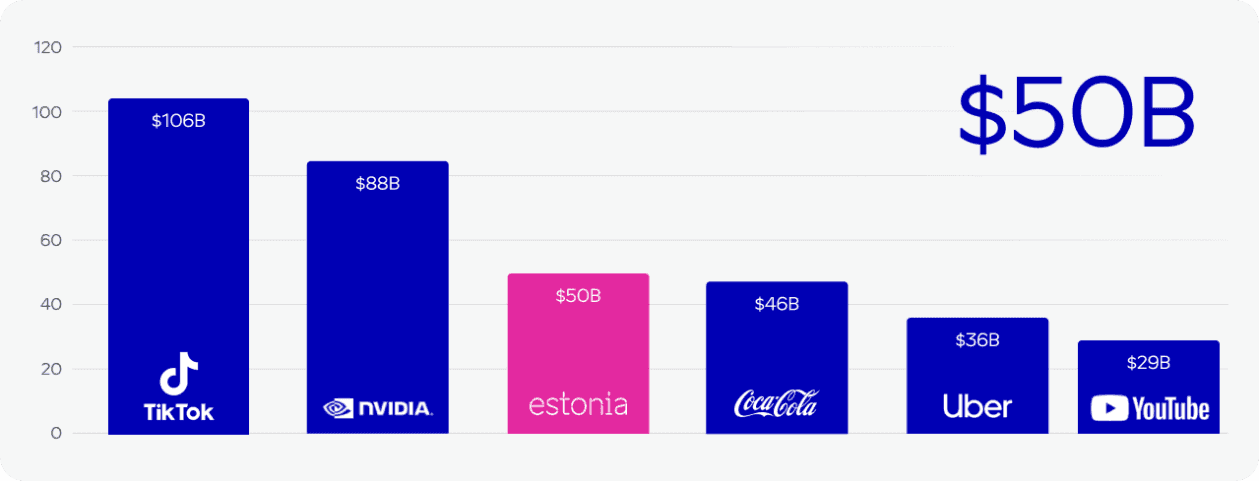
Estonia's name carries a lot of weight and our brand is valued. Our brand, despite having just 1.3 million people, ranks in the same league as some of the biggest tech brands in the world. It isn’t because we have a massive ad budget or flashy marketing campaigns. It’s because from our tiny size, we’ve built something people notice, trust, and genuinely respect. In short: we punch way above our weight. Not by shouting louder, but by delivering consistently. And that matters. Because trust isn’t just a feel‑good metric, it’s what opens doors, for partnerships, investment, and scaling companies like yourself.
Business-friendly environment and sustainable innovation
Easy to do business remains significantly more important for Estonia than other nation brands, highlighting our pro-business environment and digital-first governance. Perceptions of political stability and future potential also give Estonia a premium.
Green energy and technology investment is also a key strength for Estonia compared to other nation brands, underscoring the country’s leadership and ongoing commitment to innovation in this space. General tech and innovation imparts extra points to Estonia too.
Reliable international partner
Helpful to countries in need and trustworthiness continue to have a higher importance and this is most likely related to Estonia’s involvement and stance in the Russia-Ukraine war.
Internationally admired government leaders is also key in driving reputation for Estonia. While they may not be universally known, they are admired among those in the know, boosting Estonia’s Reputationr
Friendly people
Being perceived as friendly matters more for Estonia than for many other countries. This creates an opportunity: our people can act as ambassadors for Estonia, deepening understanding and strengthening our image.
From invisibility to recognition
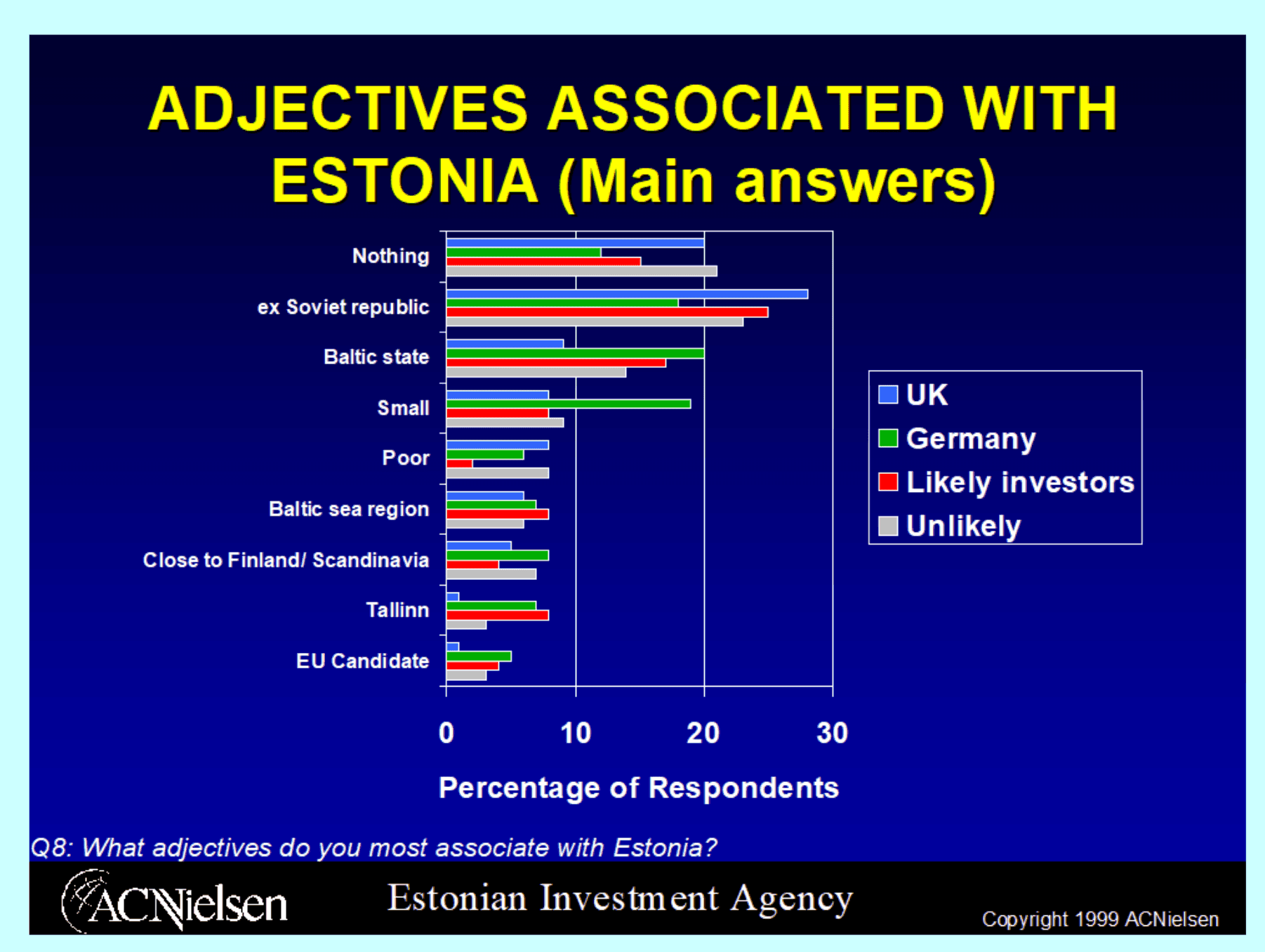
In 1999, one of the first international reputation studies by Nielsen showed that many respondents associated Estonia with “nothing” at all. For a newly independent country, this reflected not negativity, but near invisibility. Twenty-five years later, the picture is fundamentally different. Today, Estonia is recognised globally for its digital governance, business-friendly environment, education system and innovation capacity. This shift did not happen overnight, nor through advertising alone. It is the result of long-term, consistent choices: building systems that work, acting predictably and transparently, and showing up internationally with substance. The contrast between these two moments highlights how far Estonia’s global image has evolved—and why reputation-building remains a strategic asset that must be actively maintained.
Learnings from this year’s results
The momentum for reputation growth is slowing
The halo effect from Estonia’s support for Ukraine is fading. This confirms the need for a coordinated, long-term nation branding strategy that is not just reactive visibility tied to geopolitical events.
Regional shifts to watch
This year, Estonia saw declines in perceptions in Nigeria, Pakistan, and on the contrary a very positive momentum in India and China.
Estonia has strong reputation and influence in Europe and Oceania, and a momentum in Latam, especially in Brazil. Weak performance and declining reputation in North America remains a strategic risk that requires priority attention.
Shifts in global driver importance
Sustainability and Governance - where Estonia does well - decline as people focus on more immediate needs and/or turn towards populist ideologies.
Tourism and People & Values grow in importance as travel industry expands - currently Estonia’s weaknesses.
Influential media on the up as modern media become tools of soft power in their own right - opportunity for Estonia with a digital-first image
Low Familiarity globally undermines Estonia’s security
Strong results for Reputation and Influence in Europe, but also in Oceania, pointing to potential in this region. Difficult to prioritise all regions, but weak results in North America need urgent addressing – leverage geopolitics to build salience
Stay the course on promoting key strengths in tech and innovation as well as sustainability and governance
While the latter two are losing importance relative to other drivers, they remain key to building reputation. All also help build a more robust image of Estonia’s economy as not only developing, but developed - more premium like in the other Nordic countries. Plus, Estonia receives a perceptions premium from respondents that recognise its achievements in these spaces, especially tech and innovation.
Build up and scale offering in tourism and culture
Importance of tourism and people perceptions is on the up while Estonia lags behind competitors in these fields. However, those that experience Estonia through tourism and culture have a more positive view of the nation brand.